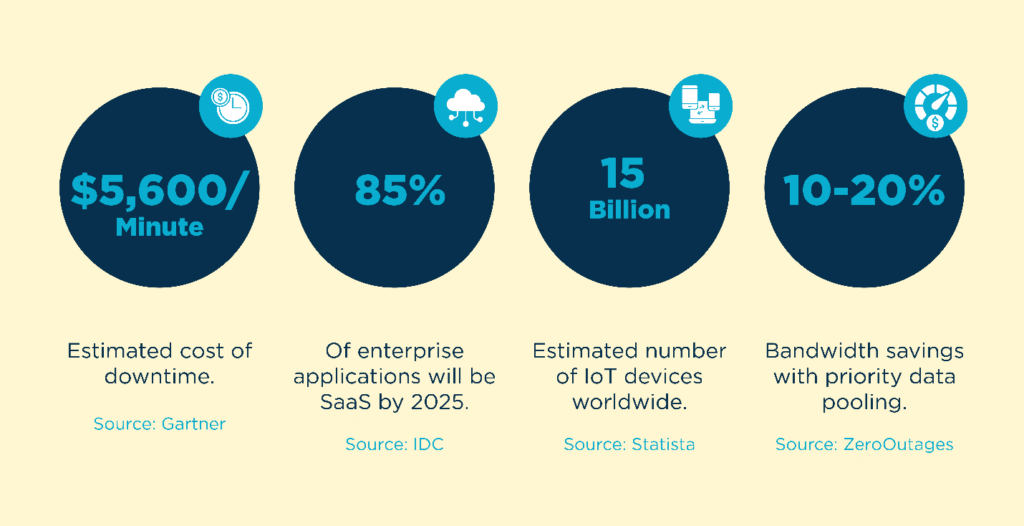
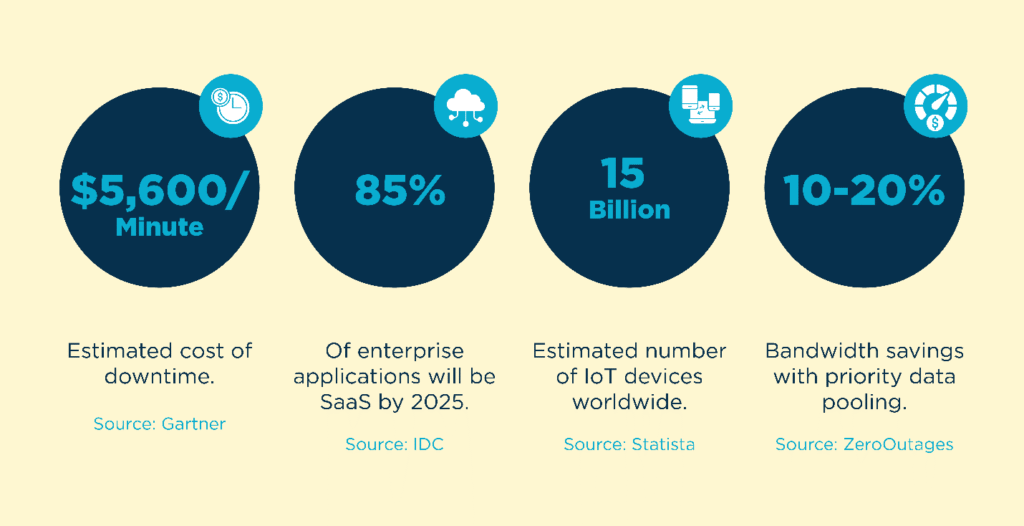
Business continuity isn’t optional anymore. With most mission-critical applications now living in the Cloud—from EMR systems and POS platforms to UCaaS and CRM tools—organizations need connectivity that stays up, even when their carrier doesn’t. A single outage can disrupt revenue, slow operations, and disconnect teams, which is why redundancy and resiliency have become minimum requirements in modern network design.
The stakes are even higher as workforces become more distributed, and operations expand beyond traditional coverage areas. Remote employees, mobile fleets, field teams, and IoT devices all rely on stable access to Cloud applications—often in locations where fiber or cable is unreliable or unavailable. Ensuring application performance across these environments requires redundancy that goes beyond simply adding a second ISP. Businesses need path diversity, carrier independence, and intelligent failover that preserves performance, not just connectivity.
This is where modern solutions like Starlink + Peplink illustrate what effective redundancy looks like in practice. As organizations become more Cloud-dependent, Peplink turns Starlink’s global satellite coverage into enterprise-grade continuity. When a primary circuit fails, failover is instant and automatic—keeping critical applications like VoIP, Teams, EMR systems, and POS transactions running without interruption. This directly supports the core requirement: ensuring Cloud access remains stable during outages.
The same applies to remote and hard-to-reach locations. Starlink provides the reach; Peplink adds the intelligence—SD-WAN steering, QoS shaping, static IPs, and traffic prioritization that raw satellite connectivity can’t offer. The result is consistent application performance for home offices, vehicles, pop-up sites, and IoT environments, even miles beyond terrestrial infrastructure.
Cost and operational efficiency also play a role. Many organizations don’t want a second ISP contract solely for backup. With Peplink, Starlink becomes a fully managed failover circuit—complete with monitoring, ticketing, and priority data pooling that can reduce usage costs by 10–20%. IT teams get fewer truck rolls and zero-touch activation, while businesses get reliable continuity without doubling their connectivity spend.
This approach aligns perfectly with modern redundancy goals:
- Uninterrupted application performance during outages
- Reliable Cloud access for remote and distributed teams
- Connectivity in locations fiber can’t reach
- Lower operational costs with a managed backup solution
- Enterprise stability without carrier dependence
Instead of treating redundancy as a backup plan, organizations are now building it into their core architecture—ensuring resilience, productivity, and stability no matter where employees work or where operations take them.
By guiding customers toward strategies like Starlink + Peplink, FlexScale Networks helps build networks that remain available, secure, and high-performing—because in a Cloud-first world, staying online isn’t just an IT goal. It’s a business imperative.